
MDF, OSB, or Plywood? Choosing the Right Sheet Material for the Job
Confused by MDF, OSB and plywood? This UK guide explains strengths, grades, moisture risks, finishes and the right board for each job.
This post may contain affiliate links. If you make a purchase through these links, we may earn a commission at no additional cost to you.
There is a particular kind of silence in the timber aisle of a British builders’ merchant. It is not peaceful. It is the silence of someone standing in front of stacks of brown, beige, and speckled boards, pretending to understand the difference between MDF, OSB, and plywood while quietly wondering whether the wrong choice will sag, swell, split, or cost twice as much as it should. A sheet material looks simple: flat, rectangular, obedient. Yet hidden inside that board is a whole world of fibres, flakes, veneers, glue lines, standards, moisture ratings, screw-holding strength, surface finish, and trade habit.
Choosing between MDF, OSB, and plywood is not really about picking “the best” board. It is about matching the board to the job. A beautifully painted alcove unit, a shed roof deck, a bathroom subfloor, a garage workshop wall, a kitchen carcass, a loft deck, and a temporary site hoarding all ask different questions of the material. Some need a smooth face. Some need structural stiffness. Some need moisture resistance. Some simply need to be cheap, flat, and available on a Saturday morning.
This guide is written for the reasonably intelligent British reader who wants clear answers without being patronised. By the end, you should know not only what MDF, OSB, and plywood are, but why they behave the way they do, where each one shines, where each one fails, and how to choose sheet material with the calm air of someone who has been doing it for years.
Quick Answers About MDF, OSB, and Plywood
Is MDF, OSB, or plywood best for DIY furniture?
MDF is usually best for painted indoor furniture such as wardrobes, alcove units, shelves, and cabinet doors because it has a smooth, uniform surface and takes paint well. Plywood is better if you want strength, exposed edges, or a natural timber look. OSB is rarely chosen for fine furniture unless its textured look is intentional.
Which sheet material is strongest: MDF, OSB, or plywood?
Plywood is generally the strongest and most versatile of the three, especially where screw holding, stiffness, and impact resistance matter. OSB can be very strong for structural sheathing and flooring when correctly graded. MDF is dense and stable, but it is not normally used as a structural board because it can sag and loses strength when wet.
Can MDF, OSB, or plywood be used outside?
Plywood and OSB can be used outside only if the correct grade is chosen and the board is protected. Exterior-grade plywood, properly sealed, is often used for demanding external work. OSB/3 or OSB/4 can handle humid structural settings but still needs protection from prolonged rain. Standard MDF is unsuitable outdoors.
What is the best sheet material for a shed roof?
OSB/3 is commonly used for shed roofs in the UK because it is strong, cost-effective, and designed for load-bearing use in humid conditions. Plywood can also be used and may be preferable for higher-quality builds. Standard MDF should not be used for shed roofs because moisture will quickly damage it.
Is MDF dangerous to cut?
MDF is not dangerous when handled sensibly, but cutting it creates very fine dust, and dust control matters. Use extraction, wear a suitable mask, and avoid breathing the dust. MDF may also release small amounts of formaldehyde from resins, so good ventilation and compliant low-emission boards are important.
Why is plywood more expensive than OSB or MDF?
Plywood is made from thin layers of timber veneer peeled or sliced from logs, then bonded with alternating grain directions. That process uses higher-quality wood and creates a board with excellent strength and stability. OSB and MDF make more use of smaller wood strands or fibres, which often keeps costs lower.
What is the best board for painting?
MDF is normally the best sheet material for a painted finish. Its smooth, fibre-based surface has no visible grain, knots, or flake pattern. The edges are absorbent and must be sealed before painting, but with primer and preparation, MDF can produce a crisp finish on shelves, panelling, skirting, and cabinets.
What should I use for a bathroom floor?
For a bathroom floor, choose a moisture-suitable structural board, not standard MDF. Plywood rated for humid conditions or appropriate tongue-and-groove structural panels are common choices. OSB/3 may be used in some situations, but detailing is vital. Edges, joints, ventilation, leaks, and floor covering all affect performance.
What Are MDF, OSB, and Plywood? A Plain-English Definition Before the Details
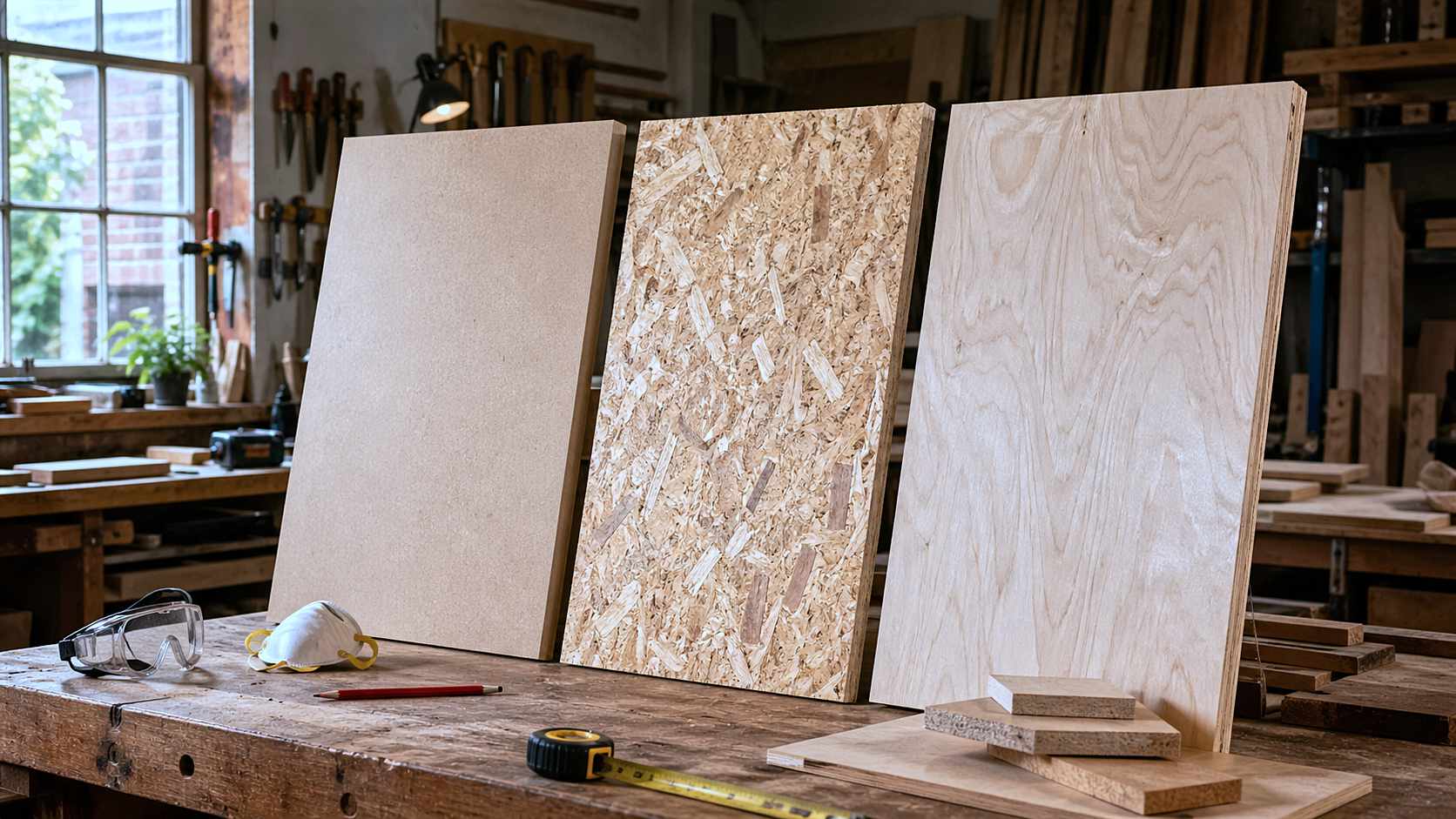
The simplest way to understand sheet materials is to picture three different approaches to solving the same problem: how do you turn trees, fibres, or timber pieces into a flat, predictable board?
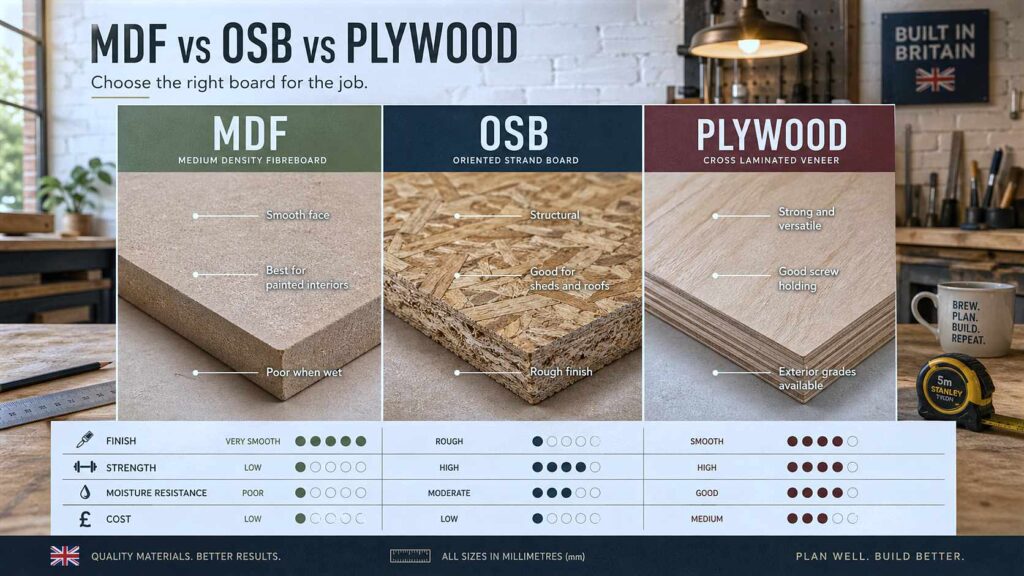
MDF, or medium-density fibreboard, is made from wood fibres bonded with resin into a dense, smooth panel.Imagine timber reduced almost to fluff, mixed with adhesive and wax, then pressed under heat into a clean, uniform sheet. Because the structure is even throughout, MDF cuts smoothly, machines well, and has no knots, grain direction, or voids to catch you out.
OSB, or oriented strand board, is made from large wood strands arranged in layers and bonded into a structural panel. Those visible flakes are not random decoration. In a good OSB panel, the strands are deliberately oriented so the board has useful strength in particular directions, rather like a crowd of matchsticks organised into disciplined ranks.
Plywood is made from thin sheets of timber veneer glued together with the grain direction alternating from layer to layer. This cross-lamination gives plywood its famous balance of strength, stiffness, and dimensional stability. It is the sheet material closest in spirit to solid timber, but less prone to the movement and splitting that can make wide solid boards troublesome.
At first glance, that sounds like a manufacturing footnote. It is not. The way each board is made explains nearly everything: how it cuts, how it screws, how it paints, how it resists water, how it fails, how much it costs, and whether it belongs in a bookcase or under roof felt.
How Did Sheet Materials Become So Common? The Short History of Engineered Wood
The rise of sheet materials is the story of timber learning to behave itself. Solid wood is beautiful, but it moves. It cups, twists, shrinks, swells, cracks, and occasionally does something unprintable just after you have finished painting it. For centuries, joiners and carpenters managed this with skill: frame-and-panel doors, seasoned timber, careful joinery, and a patient understanding of grain.
Plywood has the oldest modern pedigree of the three. Laminated wood is not a new idea, but industrial plywood grew rapidly in the nineteenth and twentieth centuries as rotary veneer cutting, improved adhesives, and mass production made large panels practical. It found uses in furniture, aircraft, boatbuilding, packaging, formwork, and construction. During the twentieth century, plywood became the quiet workhorse of modern building: strong, flat, and reliable enough to replace many assemblies that would once have needed several separate planks.
MDF arrived later as a refined descendant of fibreboard technology. Its great gift was smoothness. For furniture factories, shopfitters, and later DIY kitchens and wardrobes, MDF offered a stable, consistent, paintable board that could be routed, profiled, and cut without the surprises of natural timber. Britain’s appetite for fitted storage, painted cabinetry, skirting, architraves, and decorative wall panelling helped make MDF feel almost unavoidable.
OSB became prominent as the construction industry looked for efficient structural panels made from smaller, fast-growing timber. It is a product of industrial pragmatism. Rather than needing large logs suitable for veneer, OSB uses strands arranged in layers to achieve reliable structural performance. Its rough, speckled face, once seen mostly on building sites, has even become fashionable in some interiors, which proves that design taste can make almost anything chic if given enough time and the right lighting.
So why does that matter? Because these materials were not invented for identical jobs. They emerged from different needs: plywood for strength and versatility, MDF for smoothness and machining, OSB for economical structural sheathing. Their histories are clues to their best uses.
How Is MDF Made? Smooth Fibres, Resin, and the Search for a Perfect Paint Finish
MDF is made by breaking down wood into fibres, mixing those fibres with resin and wax, and pressing them into dense sheets. The result is a board with a consistent internal structure and a very smooth face.
In practice, that makes MDF a favourite for indoor joinery. It cuts cleanly with sharp tools, accepts routed profiles, and avoids the grain direction issues that come with plywood. If you want Shaker-style wardrobe doors, wall panelling, bookcase sides, media units, window boards, cabinet components, or painted shelving, MDF is often the first material a joiner will consider.
But here’s the interesting part: MDF’s smoothness is also its trap. Because it has no grain and no laminated veneer structure, it does not have the same strength-to-weight character as plywood. It is dense, heavy, and can sag over long spans if under-supported. A thick MDF shelf loaded with hardbacks can begin to bow, especially if it is wide and unsupported. Plywood of similar thickness may cope better, not because it is magically stronger in every direction, but because its veneer layers give it more structural stiffness.
MDF edges also behave differently from its faces. The face can be silky. The edge is thirsty. It soaks up primer and paint, often becoming furry unless sealed and sanded properly. Anyone who has painted raw MDF edges without preparation will know the feeling: you apply one coat, then another, then a third, and the edge still looks as if it has been drinking the paint rather than wearing it.
There are specialist MDF types too. Moisture-resistant MDF, often green-tinted, is designed to perform better in humid interior conditions. It is useful for kitchens, bathrooms, utility rooms, and skirting where occasional humidity is expected. It is not the same as waterproof MDF. Leave it in standing water or expose it to weather, and it will still deteriorate. There are also fire-retardant MDF boards, exterior-labelled proprietary MDF products, and veneered MDF, but each should be chosen by specification rather than by wishful thinking.
For safety, MDF deserves a sensible word. Cutting or sanding it produces very fine dust. The dust is the main practical issue for DIY users and tradespeople. Use dust extraction, wear a properly fitted mask, cut outdoors or in a ventilated workspace where possible, and clean up with a vacuum rather than sweeping clouds into the air. Modern compliant boards are manufactured to emission standards, but that does not make MDF dust something to casually breathe over a weekend of enthusiastic routing.
Where MDF Works Best
MDF is excellent for painted indoor joinery, built-in wardrobes, decorative panelling, cabinet doors, shelving with adequate support, speaker boxes, display units, shopfitting, model-making, and interior mouldings. It is particularly useful when the finish matters more than the grain.
Where MDF Is a Poor Choice
Avoid standard MDF for external work, wet areas without protection, structural flooring, roof decking, shed walls exposed to damp, and any long unsupported shelf carrying heavy loads. If the job involves weather, heavy loads, or repeated impact, MDF is usually the wrong starting point.
How Is OSB Made? Big Wood Strands, Structural Layers, and Building-Site Practicality
OSB is made from large wood strands arranged in layers, bonded with resin, and pressed into boards. Its strength comes from the orientation of those strands, which helps it act as a structural panel rather than a random mat of flakes.
OSB looks honest in a way that some people love and others cannot forgive. Its surface is busy, woody, and industrial. On building sites, that is rarely the point. OSB is valued because it offers good structural performance at a relatively modest price. It is commonly used for roof decking, wall sheathing, flooring, site hoarding, packaging, and timber-frame construction.
The important detail is grade. In the UK and Europe, OSB is classified under EN 300. You may see OSB/2, OSB/3, and OSB/4. For most building work, the familiar name is OSB/3, which is designed for load-bearing use in humid conditions. OSB/4 is a heavy-duty load-bearing board for more demanding conditions. OSB/2 is for load-bearing use in dry conditions. General-purpose non-structural boards are a different matter again.
This is where many mistakes happen. People talk about “OSB” as if it were one thing. It is not. The board used behind roof felt on a garden building is not chosen simply because it has flakes in it. It is chosen because its grade, thickness, span rating, fixing pattern, and edge support suit the job.
OSB resists racking forces well, which is why it is so useful in timber-frame walls. A frame made from studs can distort like a rectangle pushed into a parallelogram. Add structural sheathing, fix it properly, and the wall becomes much stiffer. The OSB is not decorative wallpaper; it is part of the structure.
But OSB has limits. It can swell at edges if repeatedly wetted, particularly if water gets into cut edges and joints. Exposed OSB left in British weather for too long can suffer, because “humid conditions” in a standard do not mean “abandoned in rain for months behind a half-finished project”. Temporary exposure during construction may be acceptable for suitable products, but permanent exposure requires protection, detailing, and sometimes a different material.
Where OSB Works Best
OSB is well suited to shed roofs, timber-frame sheathing, subfloors, garage walls, temporary hoarding, workshop linings, packaging, and structural boarding where appearance is secondary to strength and cost. Tongue-and-groove OSB flooring panels are common for platforms and decking applications when correctly specified.
Where OSB Is a Poor Choice
OSB is usually a poor choice for fine painted furniture, exposed joinery requiring a smooth surface, wet external work without protection, delicate edge detailing, and applications where a high-quality decorative finish is required. It can be painted, but persuading OSB to look refined is rather like asking a rugby forward to pass unnoticed at a ballet audition.
How Is Plywood Made? Veneers, Cross-Grain Strength, and the Board That Does Nearly Everything
Plywood is made by gluing thin timber veneers together with each layer’s grain running at right angles to the next. This cross-grain structure gives plywood a strong, stable, and versatile character.
Plywood is often the safest answer when you need strength, screw-holding power, and reliability. It is used in floors, roofs, walls, furniture, cabinets, vehicle lining, formwork, boats, stages, workshops, crates, and architectural interiors. It can be rough and cheap, beautiful and expensive, structural and hidden, or decorative and proudly exposed.
The catch is that plywood varies enormously. Saying “plywood” is rather like saying “car”. It tells you the general family, not whether you are dealing with a small hatchback, a delivery van, or something with walnut trim and a price that makes your tea go cold.
There are hardwood plywoods, softwood plywoods, birch plywood, poplar plywood, marine plywood, shuttering plywood, flexible plywood, fire-rated plywood, phenolic-faced plywood, and veneered decorative plywood. Some are intended for structural work. Some are intended for interior furniture. Some are made for formwork and will not give you a cabinetmaker’s finish. Some imported plywood has excellent faces but inconsistent cores; some has voids that make edges awkward and screw fixing less reliable.
For specification, two standards matter to ordinary readers more than the numbers might suggest. EN 636 relates to plywood use classes: dry, humid, or exterior conditions. EN 314 relates to bond quality, meaning the glue line’s suitability for different moisture exposure. If plywood is being used structurally or in damp conditions, the marking and documentation matter. Guessing from the colour of the board is not enough.
Marine plywood is another commonly misunderstood phrase. Proper marine plywood is not simply “waterproof plywood”. It is manufactured to a high standard with durable glue and strict controls on veneer quality, often associated with boatbuilding and demanding wet environments. For a garden planter or exterior sign, marine plywood may be overkill; for a boat repair, cheap “external ply” may be a false economy with consequences beyond a peeling edge.
Plywood takes screws well, especially into the face. It is usually better than MDF for structural fixing and better than OSB for exposed edges or neat joinery. It can also be finished attractively. Birch plywood edges, with their stacked veneer lines, became a design feature in modern interiors, cafés, schools, offices, and self-build homes. British architects and makers have embraced it for furniture, kitchens, stair details, and wall linings where the construction itself becomes part of the visual language.
Where Plywood Works Best
Plywood is excellent for structural floors, roof decks, cabinets, workshop jigs, furniture, shelving, wall linings, vehicle fit-outs, exterior projects with the correct grade and protection, and jobs needing strong screw fixings. It is the most versatile of the three materials.
Where Plywood Is a Poor Choice
Plywood may be the wrong choice when the surface must be perfectly smooth for paint at low cost, when the budget is tight and OSB will do, or when the grade is unknown. Low-quality plywood can contain voids, warped sheets, poor face veneers, and inconsistent cores. Buying plywood blindly is a surprisingly efficient way to purchase disappointment by the square metre.
MDF vs OSB vs Plywood: Which Sheet Material Should You Choose?
The best choice depends on the job. That sounds obvious, but it is the central rule. Sheet materials are not ranked like Olympic finalists. They are more like kitchen knives: you can technically cut bread with a paring knife, but you will not enjoy the process.
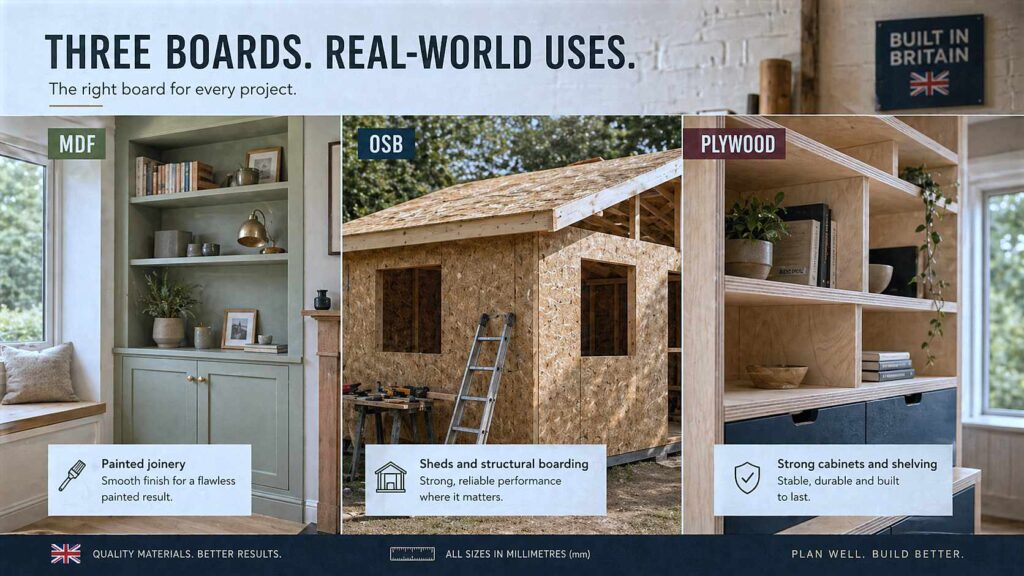
If You Need a Smooth Painted Finish, Choose MDF
For painted cupboards, wardrobes, panelling, shelving, and interior trim, MDF is hard to beat. Its face is smooth, its density is even, and it machines cleanly. Use MR MDF in humid rooms, seal edges carefully, prime properly, and support shelves over long spans.
If You Need Economical Structural Boarding, Choose OSB
For roof decking, wall sheathing, shed construction, workshop walls, and temporary site boards, OSB is often the practical answer. Choose the right grade, usually OSB/3 for humid load-bearing construction, and protect it from prolonged wetting.
If You Need Strength, Screw Holding, and Versatility, Choose Plywood
For floors, robust shelves, cabinets, exterior projects, vehicle lining, workbench tops, and mixed structural-joinery tasks, plywood is often worth the extra cost. Specify the right grade for moisture exposure and check the core quality if edges or fixings matter.
A Simple Decision Table
|
Job or Requirement |
Best First Choice |
Why |
|---|---|---|
|
Painted alcove cabinets |
MDF |
Smooth, stable, easy to machine |
|
Shed roof deck |
OSB/3 or plywood |
Structural, economical, suitable with protection |
|
Bathroom subfloor |
Suitable plywood or structural board |
Better moisture and structural performance |
|
Exposed modern furniture |
Birch plywood |
Attractive edges and strong structure |
|
Cheap garage wall lining |
OSB |
Tough, practical, cost-effective |
|
Long heavy bookshelf |
Plywood |
Better stiffness and screw holding |
|
Decorative wall panelling |
MDF |
Crisp routed profiles and paint finish |
|
Temporary hoarding |
OSB |
Robust and economical |
|
Outdoor sign backing |
Exterior-grade plywood |
Better face and edge performance when sealed |
|
Kitchen plinths or panels |
MR MDF or plywood |
Depends on finish and moisture risk |
What Do the Grades Mean? Understanding EN Standards Without Getting Lost
Standards are the dull-looking labels that stop buildings becoming experiments. For sheet materials, they help answer three basic questions: can the board carry load, can it tolerate moisture, and will its glue line survive the intended environment?
For OSB, EN 300 defines performance classes such as OSB/2, OSB/3, and OSB/4. OSB/3 is the familiar load-bearing board for humid conditions. OSB/4 is for heavy-duty load-bearing use in humid conditions. For a UK shed roof, timber-frame wall, or floor deck, this distinction matters.
For plywood, EN 636 describes suitability for dry, humid, or exterior conditions. EN 636-1 is for dry conditions, EN 636-2 for humid conditions, and EN 636-3 for exterior conditions. EN 314 concerns bond quality. A plywood sheet may look respectable, but if its bond class is wrong for the job, the glue line may be the weak link.
For MDF, look at product type, moisture resistance, fire performance, and emissions class. Standard MDF is for dry interiors. MR MDF is for humid interior conditions. Fire-retardant MDF is used where fire performance is specified. Low-emission boards are increasingly important for indoor air quality and responsible specification.
For construction, CE or UKCA marking and declarations of performance may appear on products covered by relevant harmonised standards. For ordinary household work, you may not need to study every document. But you should buy from reputable suppliers and avoid mystery boards for critical uses. A board with no clear grade is fine for a temporary template. It is not fine for a floor supporting people.
Moisture, Swelling, and Rot: What Happens When Sheet Materials Get Wet?
Water is where optimism meets physics. Many sheet material failures begin with a sentence such as, “It’ll probably be all right.” Sometimes it is. Often it is not.
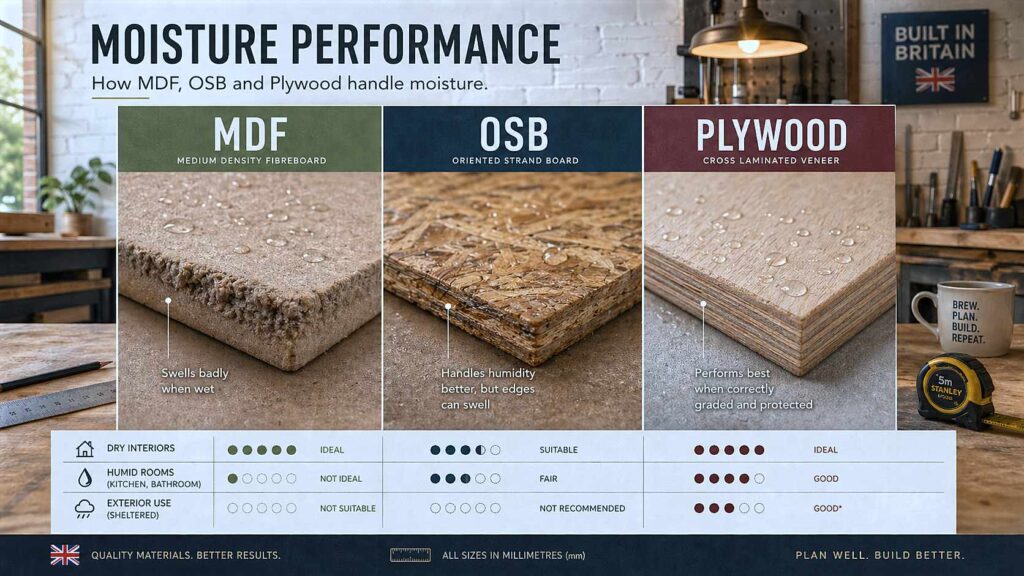
Standard MDF performs badly when wet because its fibres swell and lose integrity. Once water gets in, the board can puff, crumble, and distort. Moisture-resistant MDF improves performance in humid interior conditions, but it should not be treated as waterproof.
OSB can tolerate humid structural conditions if correctly graded, but edges remain vulnerable. Cut edges, unsealed joints, trapped water, and poor ventilation can lead to swelling. OSB used under roof coverings should be kept dry in service. If used during construction, exposure should be managed and temporary protection should be considered.
Plywood generally handles moisture better when the correct grade is chosen, but it still needs protection.Exterior-grade plywood is not a licence to ignore edge sealing, fixings, drainage, ventilation, or maintenance. Wood-based panels may contain durable glue, but the wood itself can still degrade if repeatedly soaked and allowed to rot.
The key practical point is this: moisture rating is not the same as weatherproofing. A board may be suitable for humid conditions, but if it is used outdoors, edges and surfaces often need sealing, painting, cladding, covering, or preservative treatment. In the British climate, where rain can arrive sideways and with comic timing, detailing matters as much as the product label.
Strength, Stiffness, and Screw Holding: Why Sheet Materials Fail in Different Ways
Strength is not one thing. A board can be hard but brittle, stiff but poor at holding screws, dense but prone to sagging, or strong in one direction and weaker in another.
MDF is dense and uniform, but it is not especially stiff over long spans. It holds screws reasonably well into the face if pilot holes are used, but edge screw holding can be weak and splitting or bulging may occur. Confirmat screws, specialist MDF screws, biscuits, dowels, and glue can help in furniture construction.
OSB is structurally useful but has a rougher internal structure. It performs well as sheathing or decking when supported and fixed according to specification. Screw and nail holding can be good in appropriate applications, but edges and repeated fixings need care.
Plywood usually offers the best all-round screw holding and stiffness. The alternating veneers give it strength across the board, though quality varies. A plywood sheet with many thin plies, such as good birch plywood, often feels more refined and reliable than a cheaper board with fewer thick plies and internal voids.
Consider a shelf. A short decorative shelf for ornaments may work in MDF. A long shelf loaded with tools, paint tins, or art books would be safer in plywood, thicker material, or a design with front lipping and proper support. Consider a floor. The board must span joists, carry people and furniture, resist bounce, and hold fixings. That is structural territory, and the grade, thickness, and support centres become essential.
Cutting, Fixing, and Finishing: What Is Each Board Like to Work With?
A material’s personality becomes obvious when you put a saw to it.
MDF cuts cleanly but creates fine dust. It routs beautifully, takes profiles well, and sands smoothly on faces. Edges need sealing. Use sharp blades, extraction, and masks. Pre-drill screws, especially near edges. For painting, use MDF primer or a suitable wood primer, sand between coats, and do not rush the edges.
OSB cuts easily enough but leaves a rougher edge. It is forgiving for construction work and can be fixed with nails, screws, or staples depending on the application. Its surface texture is hard to hide. If painting OSB, use primer and expect the flakes to remain visible. It can look good in workshops and contemporary interiors, but it rarely looks delicate.
Plywood is pleasant to work when the quality is good and maddening when it is poor. It can splinter across the face veneer, so use sharp blades, masking tape, scoring cuts, or a track saw for clean edges. It screws well and can be glued, lipped, veneered, oiled, varnished, painted, or laminated. Exposed plywood edges can be beautiful if the plies are neat.
For all sheet materials, thickness matters. Common UK sheet sizes are often around 2440 mm by 1220 mm, the familiar 8 by 4 foot sheet. Thicknesses might include 6, 9, 12, 18, and 25 mm, though availability varies by product and supplier. A full 18 mm board is heavy and awkward. Plan transport, cutting, and lifting before you discover that your hatchback is not, despite heroic optimism, a panel van.
Common UK Projects: Which Board Should You Use?
What Sheet Material Should I Use for Shelves and Bookcases?
For painted built-in shelves, MDF is popular, but long shelves need support. Add a front lipping strip, use thicker board, reduce the span, or choose plywood for heavier loads. For exposed modern shelves, birch plywood is attractive and strong. For garage shelving, plywood or OSB may be more practical than MDF.
What Board Is Best for Wall Panelling?
MDF is usually the best choice for decorative wall panelling because it is smooth, stable, and easy to cut into strips or routed panels. Use moisture-resistant MDF in humid rooms and keep it away from direct wetting. Prime cut edges well.
What Should I Use for a Shed Floor or Roof?
For a shed roof, OSB/3 is common and economical, provided it is covered promptly with felt, EPDM, metal sheeting, or another roof covering. For shed floors, tongue-and-groove OSB/3 or plywood can work, but ventilation and ground moisture control are vital. A cheap board over a damp base will not become expensive by surviving longer.
What Is Best for Kitchen Cabinets?
Many kitchen carcasses use melamine-faced chipboard, which sits outside our main trio but deserves mention. For bespoke painted doors or panels, MDF is common. For stronger, more premium cabinet construction, plywood may be used, especially where exposed edges are part of the design. MR MDF can be suitable for painted kitchen components, but areas near sinks need careful sealing.
What Is Best for Bathroom Projects?
Bathrooms punish lazy material choices. Use moisture-suitable boards and protect edges. MR MDF can work for painted panelling away from direct water, but it is not ideal inside shower zones or where leaks may occur. For subfloors and structural elements, suitable plywood or structural panels are a safer route.
What Board Should I Use for a Workbench?
Plywood is often the best base for a workbench top because it is strong, takes fixings, and resists knocks. MDF can be used as a sacrificial top layer because it is flat and cheap to replace. OSB is useful for rough benches, storage, and workshop walls, but its textured surface is less pleasant for fine work.
What Is Best for Loft Boarding?
Loft boarding needs care because insulation depth, ventilation, cables, and ceiling joist capacity all matter. Chipboard loft panels are commonly sold for this purpose, but plywood or OSB may be used in some designs. Do not simply lay heavy boards across undersized joists and assume the ceiling below has agreed to become a floor.
The Environmental Question: Which Sheet Material Is Most Sustainable?
Sustainability is not a single league table. It depends on forestry, manufacturing energy, resin chemistry, transport, durability, reuse, recycling, and whether the board is right for the job.
OSB and MDF can make efficient use of smaller wood pieces, fibres, and strands. That can be positive, especially when timber comes from responsibly managed forests. Plywood may use higher-grade logs, but it can last a long time and perform demanding roles that cheaper materials cannot. A durable board used correctly may be more sustainable than a cheaper one replaced twice.
Look for credible certification such as FSC or PEFC where available. Environmental Product Declarations, or EPDs, are increasingly used in construction to compare impacts more transparently. They do not make a product automatically virtuous, but they give specifiers a more reliable basis than marketing language alone.
Formaldehyde and indoor air quality also belong in this conversation. Wood itself can naturally emit tiny amounts of formaldehyde, but composite panels use resins, so emissions standards matter. In the UK, reputable suppliers should be able to provide boards meeting relevant emissions classifications. For homes, schools, and workplaces, low-emission products, good ventilation, and dust control are sensible choices.
End of life is awkward. Clean, untreated timber panels may sometimes be recycled or reused, while contaminated, painted, laminated, or resin-heavy products may be harder to process. The best environmental habit for most readers is refreshingly practical: buy the correct board, avoid waste through good cutting plans, protect it properly, and use offcuts intelligently.
Cost and Availability: Why the Cheapest Sheet Can Become Expensive
Prices vary by region, supplier, thickness, brand, certification, and timber markets. But the usual pattern is straightforward: OSB is often the economical structural sheet, MDF is economical for smooth interior work, and high-quality plywood is usually more expensive.
The trap is focusing only on the shelf price. A cheap MDF board used where plywood is needed may sag or fail. A cheap plywood with a poor core may waste hours in filling, sanding, and swearing. A cheap OSB sheet left exposed to weather may swell at the edges before the project is finished. Cost should be measured against the whole job: labour, finish, durability, waste, and replacement.
For tradespeople, time often costs more than material. MDF that paints smoothly may save finishing time. Plywood that holds screws reliably may prevent callbacks. OSB that covers a roof quickly may keep a project moving. For DIYers, the same logic applies, except the currency may be Saturday afternoons and domestic goodwill.
Debates and Misconceptions: The Sheet Material Myths That Refuse to Die
“Marine Plywood Is Always Waterproof”
Marine plywood is made for demanding wet environments, but the timber still needs correct detailing and protection. The word “marine” is not a magic spell. Edges, fixings, coatings, and maintenance still matter.
“Moisture-Resistant MDF Is Waterproof”
MR MDF is better in humid interior conditions than standard MDF, but it should not be soaked or used casually outdoors. It is moisture-resistant, not moisture-indifferent.
“OSB Is Just Cheap Plywood”
OSB is not plywood’s scruffy cousin. It is a different engineered product with its own standards, strengths, and best uses. It can be excellent in structural sheathing and decking, but it is not the same material.
“Plywood Is Always Better”
Good plywood is excellent. Poor plywood is not. For painted cabinet doors, MDF may produce a better finish. For a temporary hoarding, OSB may be perfectly sensible. “Best” depends on the job.
“MDF Is Unsafe and Should Never Be Used”
MDF requires sensible dust control and attention to emissions, but it is widely used in homes, furniture, and joinery. The hazard is managed through compliant products, ventilation, extraction, masks, and safe working methods.
Future Developments: What Is Changing in Sheet Materials?
The sheet material world is changing quietly. It will not make the evening news, but it will affect what builders, designers, and householders buy.
Low-emission resins are becoming more important as indoor air quality receives greater scrutiny. Manufacturers are developing boards with reduced formaldehyde emissions, alternative binders, and clearer environmental documentation. Fire performance is another driver, especially in commercial interiors, multi-occupancy buildings, schools, and public spaces.
Offsite construction and timber-frame building continue to increase demand for reliable structural panels. OSB, plywood, and other engineered timber boards fit well with factory-made walls, floors, cassettes, and modular systems. The more construction moves towards precision, the more board performance needs to be documented rather than guessed.
There is also growing interest in circular economy thinking. Can panels be designed for reuse? Can offcuts be reduced through digital cutting? Can take-back schemes and better sorting improve recycling? None of this removes the need to choose the right board today, but it changes the wider context in which that choice sits.
Architecturally, exposed sheet materials are no longer automatically hidden. Birch plywood interiors, OSB workshop walls, and honest timber linings have moved from utilitarian spaces into homes, studios, schools, and cafés. A board once used behind the scenes can now be the scene.
A Practical Buying Checklist: How to Choose the Right Board in Five Minutes
Before buying, ask five questions.
First, is the board structural? If it will carry weight, resist racking, span joists, or form part of a building element, choose a structural product with the right grade. Do not rely on appearance.
Second, will it get wet or humid? For dry interiors, standard MDF or interior plywood may be fine. For humid areas, choose MR MDF, OSB/3, or suitable plywood depending on the task. For exterior work, specify exterior-suitable plywood or protected structural panels and detail them properly.
Third, what finish do you want? For smooth paint, MDF is king. For exposed layered edges, plywood is attractive. For rugged utility, OSB can be left visible or painted in a deliberately industrial way.
Fourth, how will it be fixed? Screws into edges, repeated fixings, heavy loads, and mechanical stress favour plywood. MDF needs pilot holes and careful screw choice. OSB needs correct fixing patterns for structural use.
Fifth, how long should it last? A temporary template can be cheap. A bathroom floor, roof deck, or built-in cabinet should not be treated as temporary unless you enjoy doing the same job twice.
The Final Decision: Matching the Material to the Job
The right sheet material is the one whose weaknesses do not matter for your project and whose strengths you are actually using.
Choose MDF when you need a smooth, stable, paintable board for indoor joinery and decorative work. Respect its dislike of water, support it properly, and control dust when cutting.
Choose OSB when you need economical structural boarding for roofs, walls, floors, workshops, sheds, and site work. Choose the correct grade, especially OSB/3 or OSB/4 where appropriate, and protect it from prolonged moisture.
Choose plywood when you need strength, screw holding, durability, versatility, or a good-looking exposed edge. Specify the right grade for moisture and structural use, and do not assume all plywood is equal.
There is no shame in standing in the timber aisle and taking a moment. Sheet materials look plain, but they carry a surprising amount of engineering inside them. Once you understand the difference between fibres, strands, and veneers, the choice becomes far less mysterious. MDF is the smooth talker. OSB is the site-ready pragmatist. Plywood is the adaptable craftsperson. Pick the one whose character suits the job, and the board will stop being a gamble and start being a decision.
Further Reading
- Health and Safety Executive: woodworking FAQs, including MDF dust and formaldehyde guidance.
- Wood Panel Industries Federation: PanelGuide for wood-based panels in UK construction.
- Timber Development UK: guidance on timber, engineered wood, certification, and Environmental Product Declarations.
- British Standards Institution: EN 300, EN 636, EN 314, and related wood-based panel standards.
- TRADA and Timber Development UK technical publications on wood-based panel products.
- FSC UK and PEFC UK: responsible timber sourcing and certification information.


